Link to updated WORK study guide is HERE
Link to class selected AP Fr & mc questions are at the top of the study guide page HERE
THURSDAYS's QUESTIONS:
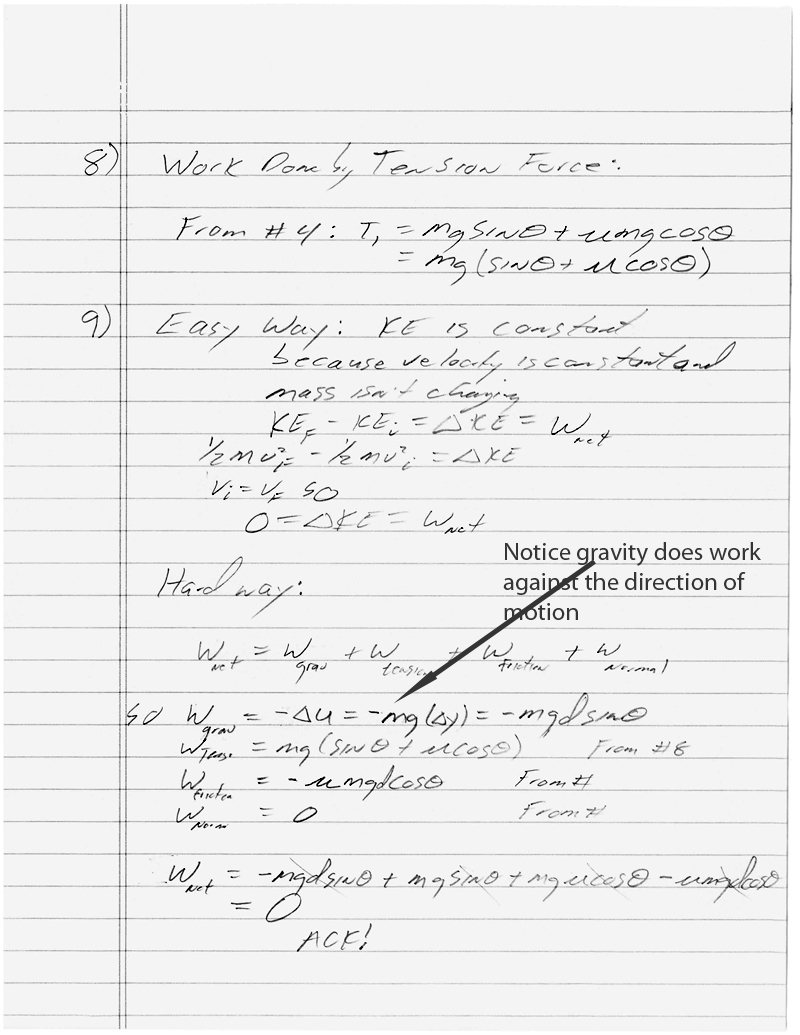
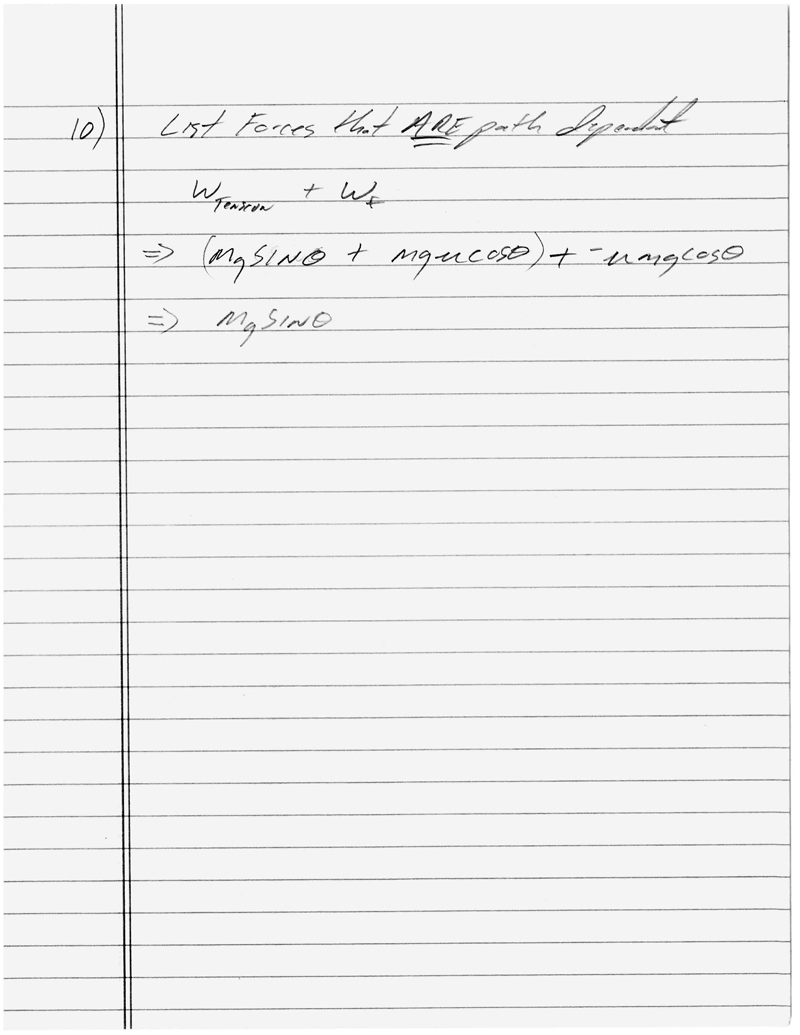
Check the bottom of the page for expanded yesterday (Thursday) explanations for 8, 9 & 10
DISCUSSIONS:
Conservative Forces:
A conservative force is a conservative force because it STORES energy. In otherwords if you start in one place, do work, then come back to where you started from, you have simply stored energy during your trip. The net result of all your work must be zero.
A conservative force is a conservative force because it *conserves* energy at the end of your trip all your work goes to 0.
A non-conservative force (for example friction) means that if you transfer or exert energy via that force you can't get it back out the same way.
DISCUSSION: HW Problem #63: We know the block is being accelerated downward by gravity with a force found by mgsinθ. We also know that the force is capable of pushing upwards on the block with a force found by kx. So, why can't we set the two forces = to each other and solve for x?
Answer: The block is IN MOTION down the ramp, which means that it is different from the case of the block being directly in contact with the spring. Since the block is in motion, it brings with it Kinetic Energy that will aid in the compression of the spring. If we don't take the KE of the block into account, we won't compress the spring nearly enough and our value for x will be too small.
Practice -- Let's try this in stages. I found this problem and then decked it out to more like a Free Response. I've added a few hints along the way:
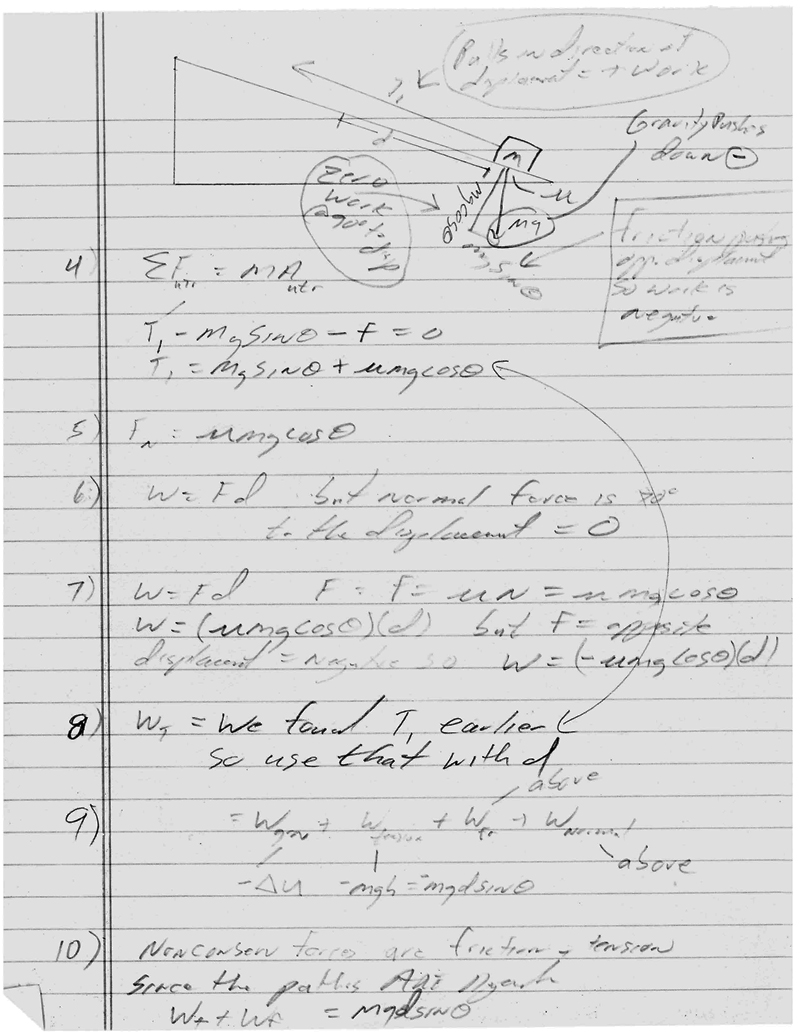
Lets say we have a wooden block with a mass (m) that is being pulled at a constant rate up by a cable up a ramp (angle θ to the horizontal) with some displacement (d) and the coefficient of friction between the block and the ramp is μ.
- Draw a force diagram that accurately represents JUST (hint: what does THAT mean?) the forces acting on or by the block.
- Identify conservative AND nonconservative forces
- Use the Khan Academy logic AND the tutor logic that we learned the other day to indicate where the work being done is positive, negative and/or zero.
-
What is the magnitude of the tension force on the rope?
-
What is the magnitude of the normal force on the block?
-
What is the work done by the normal force on the block?
-
What is the work done by friction on the block?
-
What is the work done by the tension force on the block? (be careful, there is a bit more here than you might suspect. The answer is NOT just mgsinθ (further hint provided upon request... AFTER you wrestle with it in your teams for a bit)?
-
The Work/Kinetic Energy theorem states that Wnet = ∆KE. What is the net work in this system (make sure to refer to your diagram!)
-
If the total change in mechanical energy is defined to be the change in kinetic energy plus the change in potential energy, what is the total change in energy of that system?
-
What is the net work done by the NON-conservative forces?